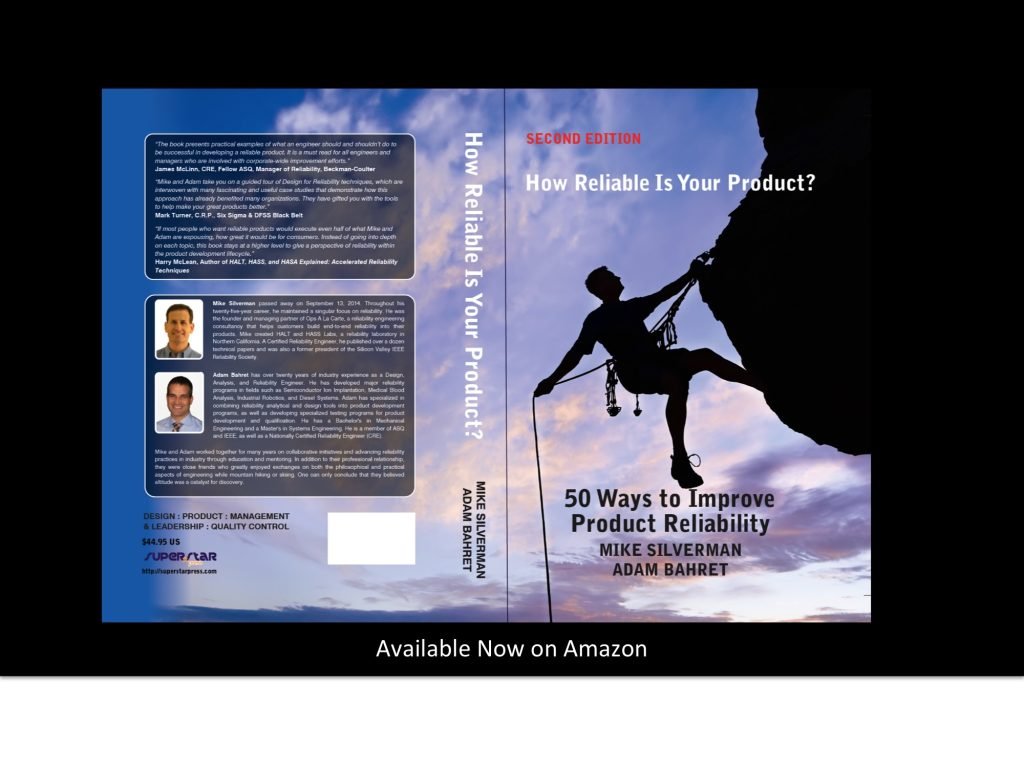
| I recommend the book as an excellent guide for engineering project management
and their teams, as well as for reliability specialists. It demystifies the sometimes
difficult methods and helps specialists to communicate with managers, designers,
and other engineers. It will make your products more reliable.
– Patrick O’Connor
Author of Practical Reliability Engineering
“50 Ways to Improve Product Reliability is a great collection of ground rules that are
based upon experience. It describes a number of situations and presents practical examples
of what engineers should do to be successful in the area of reliability. In a few
examples, it also indicates what should not be done in order to avoid problems. The book
is organized according to the phases of a project, and a maturity matrix is presented as
a means to measure progress. Many examples show proactive use of reliability tools for
hardware and software. All are accompanied by concise case studies showing how to apply
tools and handle common situations. It is a must-read for all engineers and managers
who are involved with corporate-wide reliability improvement efforts.”
– James McLinn
CRE, Fellow, ASQ
“All engineering products have to be designed and manufactured with reliability targets
having been taken into account during the product development process. From an engineering
perspective, the role of reliability within product design and development is
one that applies a systematic process of proven engineering techniques throughout the
design program. In modern engineering programs, it is no longer sufficient to view reliability
engineering as simply a verification activity; reliability cannot be tested into any
product, it has to be designed in. Therefore, the role of reliability engineering within a
product design environment can be defined as controlling warranty costs by assisting
design engineers to make great products better. A key component within any effective
product development process is Design for Reliability, which when deployed, enables
reliability principles to be employed to evaluate the inherent reliability of the product being
designed; it also identifies potential opportunities for reliability improvement. This book’s
valuable guidance on design, analysis, and product improvement activities can be used
by engineers to optimize the reliability of the products they are designing and ultimately
to insure customer satisfaction. This book is an invaluable resource for anyone who is involved
with engineering great products, from corporate managers to reliability and design
engineers alike.”
– Mark Turner
C.R.P. Six Sigma & DFSS Black Belt
“After reading 50 Ways to Improve Product Reliability, I am impressed to state that if most
people who want reliable products would execute fifty or sixty percent of what Mike and
Adam are espousing, how great it would be for consumers. Instead of going into depth
on each topic, the book stays at a higher level to give a perspective of reliability within the
product development lifecycle.”
– Harry McLean
Author of HALT, HASS, and HASA Explained: Accelerated Reliability Techniques |